A visit to the new Kyoto Yuzen project at Hata Studio: three generations of silk, hand-painted color, and unbroken craft.
A New Chapter for Kyoto Yuzen
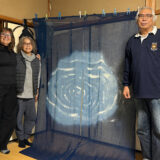
On a crisp November day in Kyoto, we slid open the door of Gallery Pal Art (ぱるあーと) to see “KIMONO by HATA,” on view from November 7 to 17. Within seconds, we knew we had come to something special.
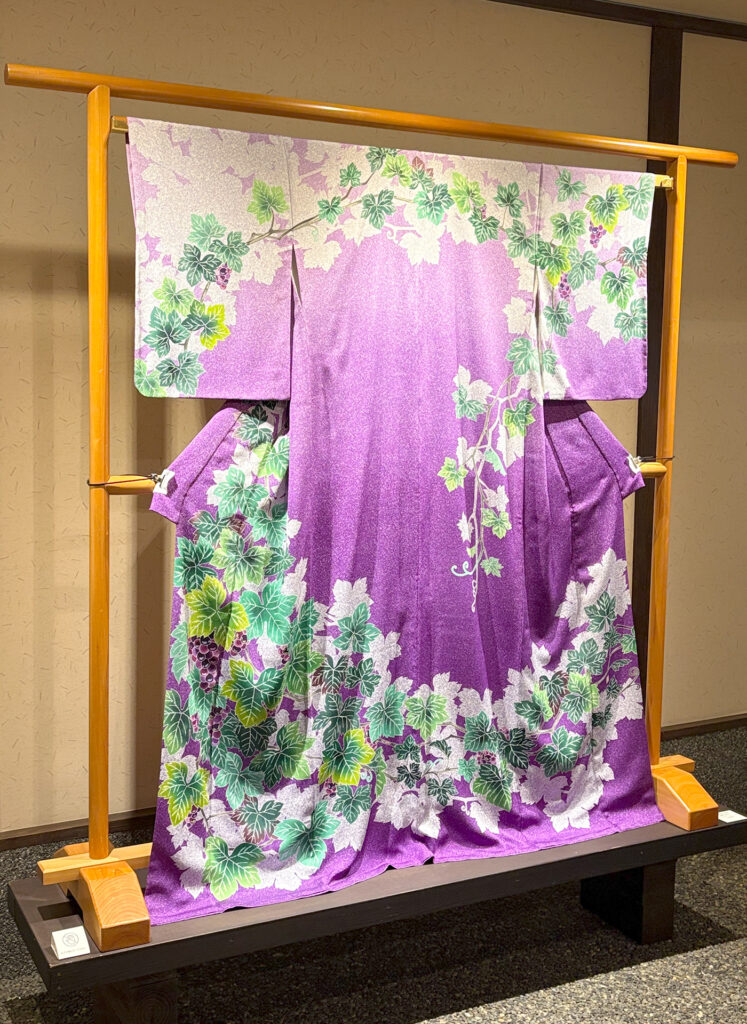
A deep violet kimono, covered in grapevines, stood before us. Its gradient rose from the hem like dusk settling over a vineyard.
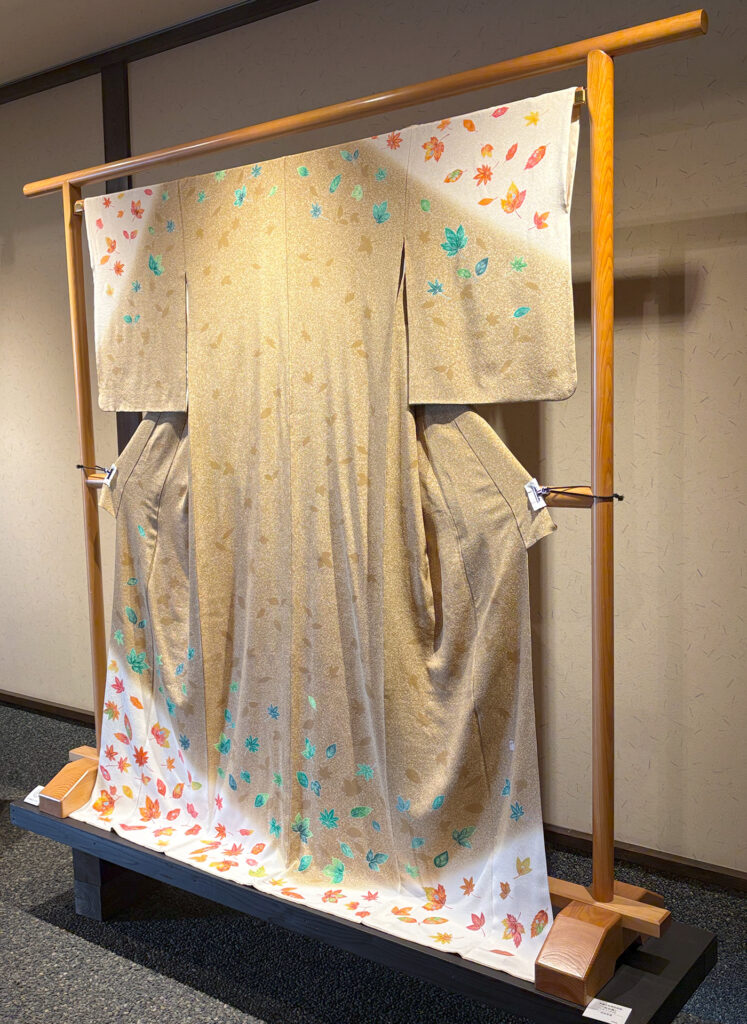
Beside it hung a second kimono scattered with autumn maple leaves, glowing in the gallery light.
This is the work of the Hata Studio (羽田工房), one of Kyoto Yuzen’s most respected names. For three generations, the studio has carried on the techniques and aesthetic of the late Living National Treasure Tokio Hata (羽田登喜男). Toki Hata (羽田登喜), an artist from the studio, also exhibits with us at Kogei Art KYOTO, so this visit felt personal. What stood before us was not simply a new collection. It was the studio’s next step.
The Core Philosophy: Sustaining the Ecosystem
Why would a studio of this standing turn toward modern fashion? The answer is the heart of this project.
A kimono is never the work of one person. It takes weavers who produce the white silk cloth, such as the famed Tango chirimen. It takes the Yuzen artists who paint it, and the wasai (和裁士), the master tailors who stitch it by hand. If any link weakens, the whole chain is at risk.
The studio’s conviction, as it was explained to us, is simple: the hands of the people who support kimono culture must never be allowed to rest.
They also hold a second belief. The skill and sensibility that go into making a kimono deserve a wider life in today’s clothes. “KIMONO by HATA” follows from both beliefs. We see it as authentic innovation that protects the kimono’s living tradition, not as kimono “remake” or upcycling.
Uncompromising Craftsmanship: All Silk, Made in Kyoto
This is what impressed us most. These pieces are not prints on ready-made fabric. The studio treats a stole or skirt the same way it would a kimono.
First, plain white silk, such as Tango chirimen, is loosely stitched into its final shape, a step called kari-jitate (仮仕立て). Only then does the artist paint the design by hand in Yuzen, composing it to fit the form the piece will take. It is the same logic as a full kimono.
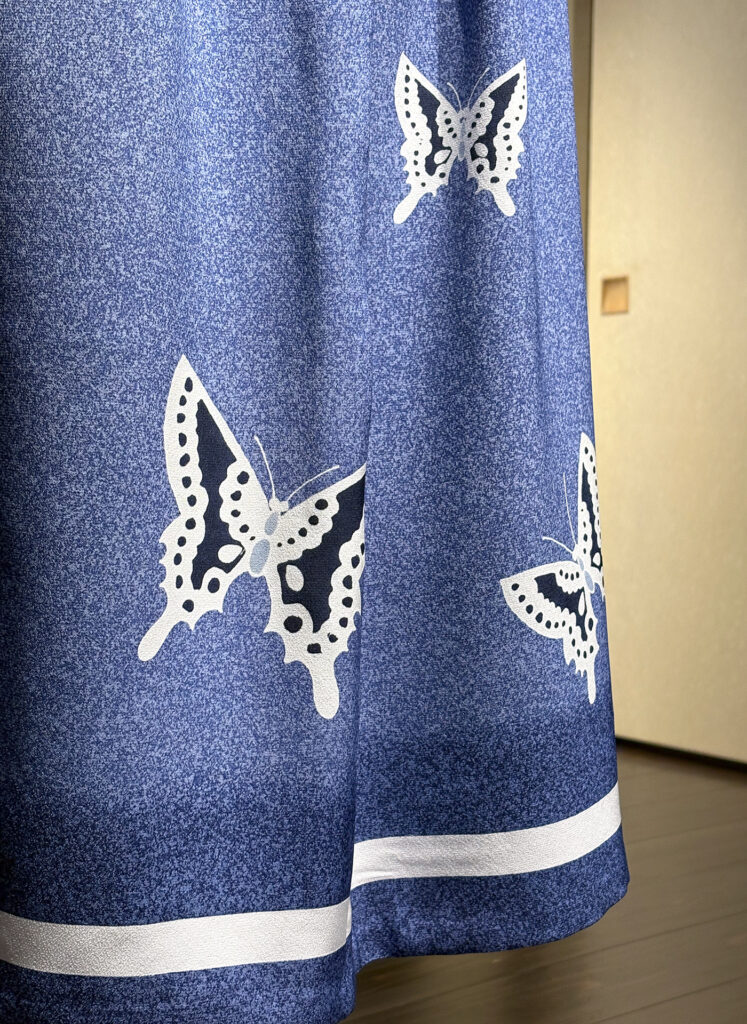
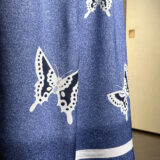
Look closely at the hem of the butterfly skirt. The fine, sandy texture of the ground and the crisp white swallowtails carry the unmistakable feel of hand-dyeing.
The sewing is done by hand, by wasai tailors, as it would be for a kimono. Even the smallest pieces follow the same rule.
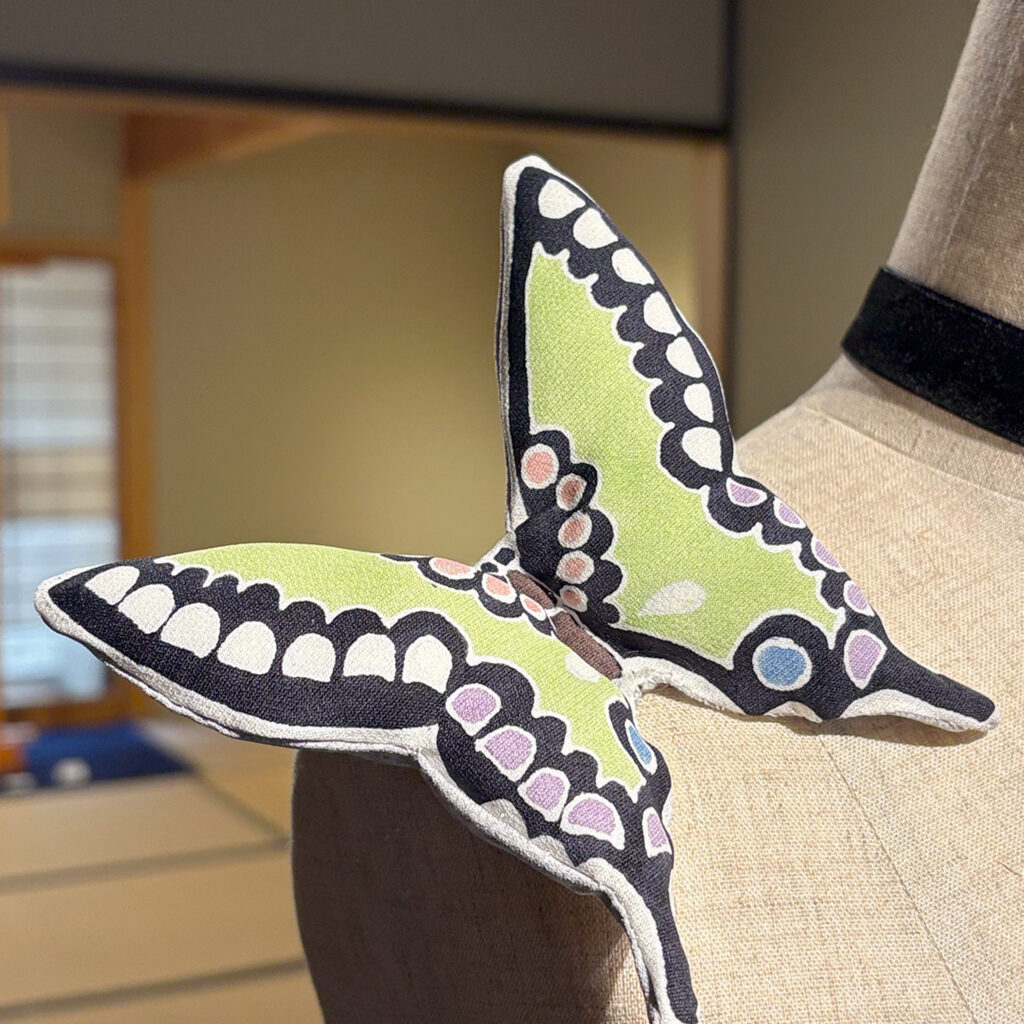
Take this butterfly brooch. It is stuffed with mawata (真綿), soft floss pulled from silk cocoons, and sewn with silk thread made in Kyoto. The result is a small, soft, dimensional piece of art with a gentle weight.
Silk fabric, silk filling, silk thread, all of it from Kyoto. At Kogei Art KYOTO, we like to call this “All Silk, Made in Kyoto.”
Wearable Art in Modern Life
Then comes the fun part: imagining it all in daily life.
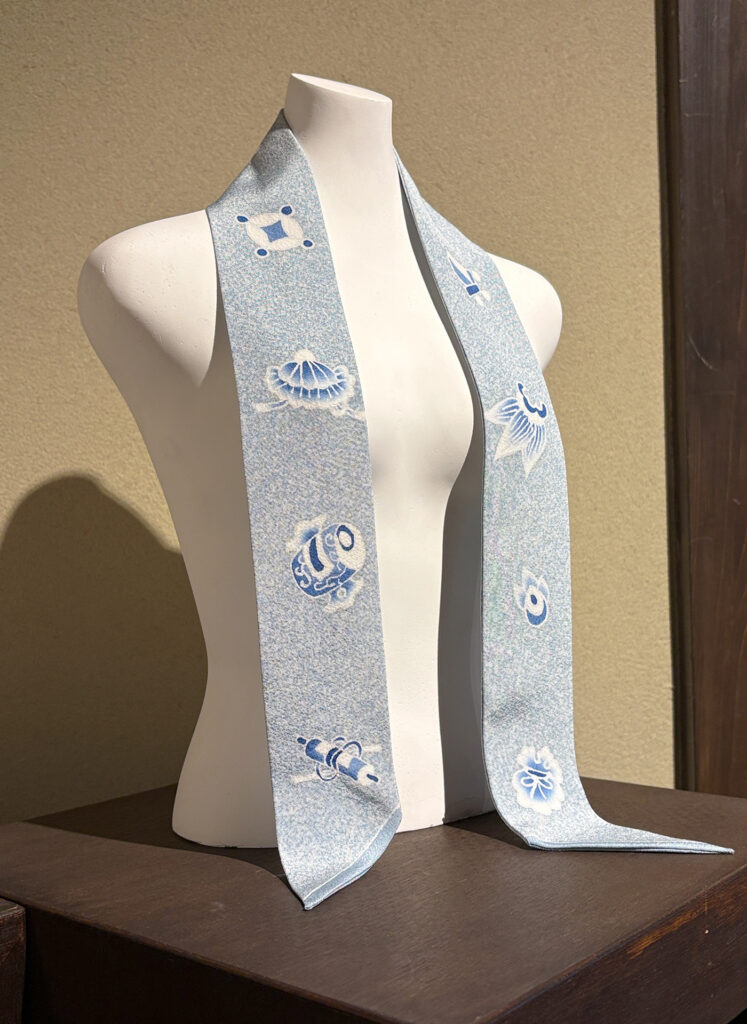
On the mannequin, the studio’s artistry becomes a skinny scarf, patterned in blue with auspicious motifs. You could knot it at the neck, tie it to a bag handle, or wear it in your hair.
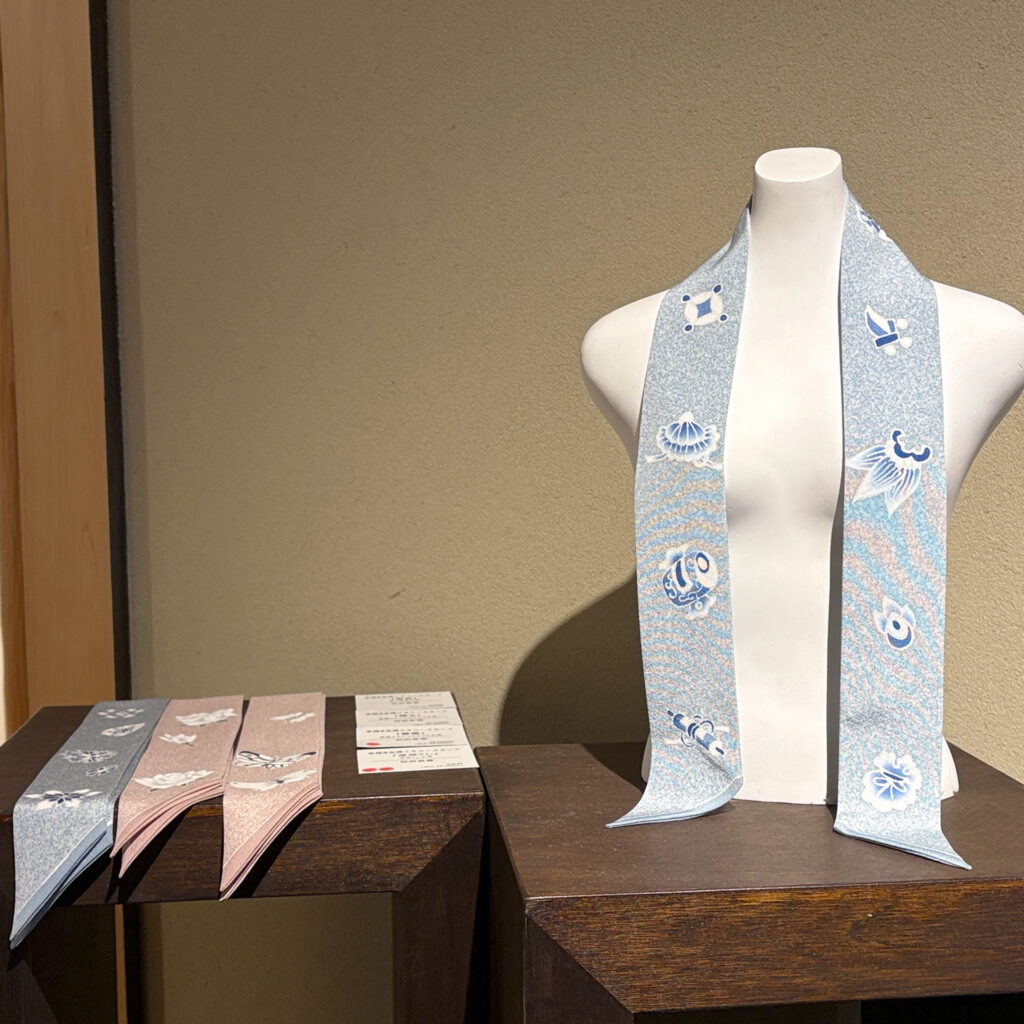
The skinny scarves come in soft blue and blush pink.
Then there are the butterflies. The blue skirt drifts with white swallowtails. Above it, brooches rest on the shoulder, at the collar and at the waist.
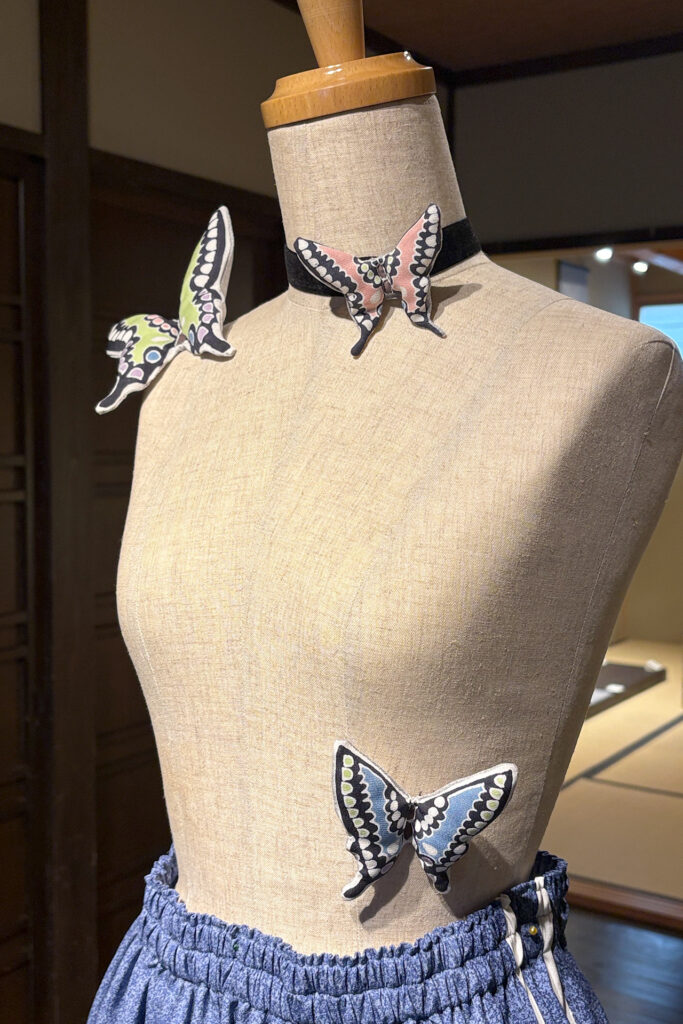
The brooches are not limited to pinning. Mr. Hata told us they can also be worn on a choker, or as a bow tie for men.
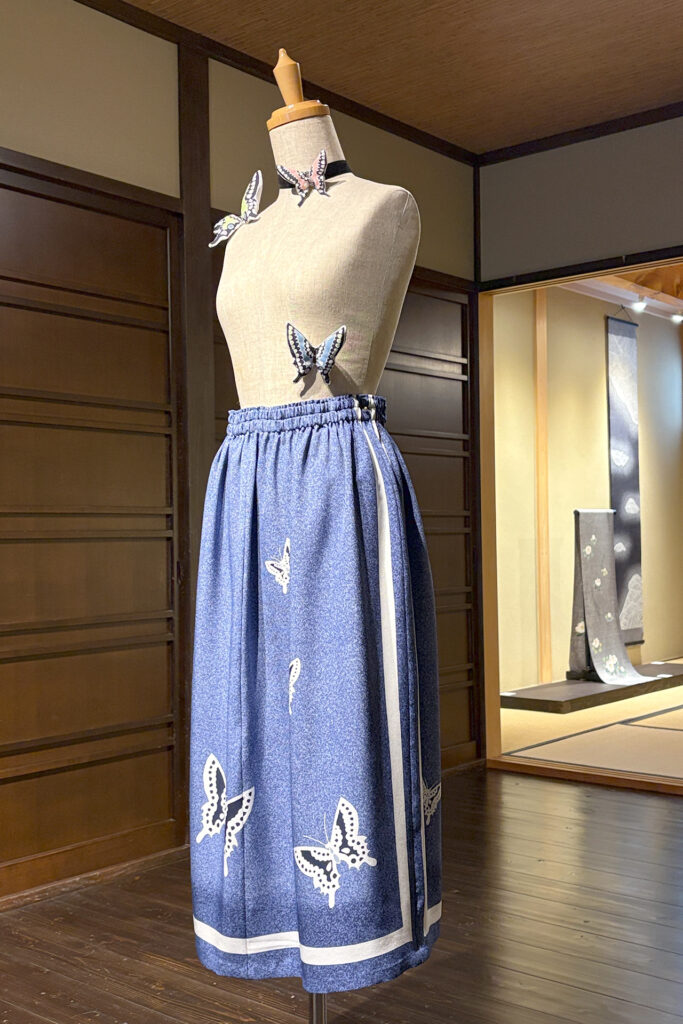
Seen from the side, the skirt moves like a quiet garden. Pinned anywhere, the butterfly brooches turn a simple outfit into something personal.
The studio also presents wider stoles. Their width matches a standard kimono bolt (kijaku, 着尺), so this too is a technique borrowed directly from kimono making.
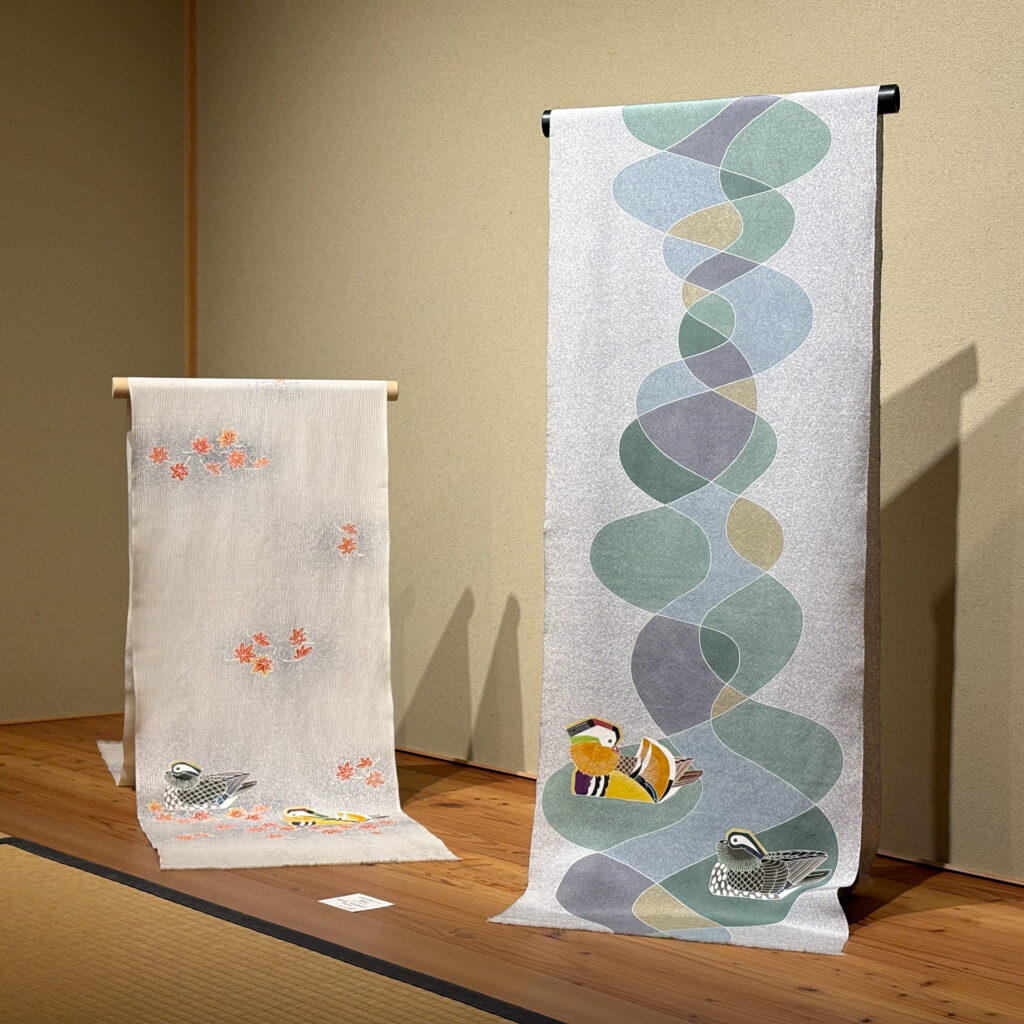
The mandarin ducks (oshidori), the Hata Studio’s signature motif, swim through flowing, interlocking waves of green and blue. In Japan, these birds symbolize devoted pairs.
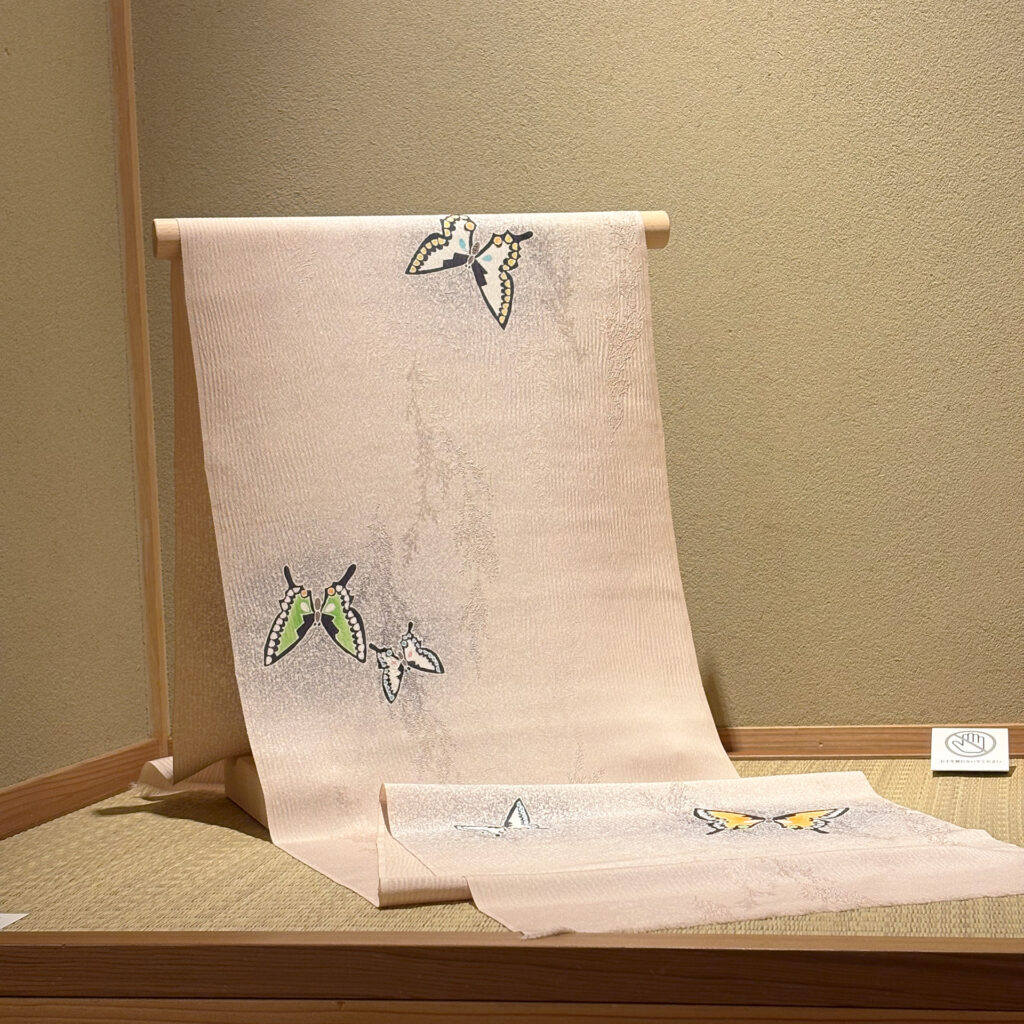
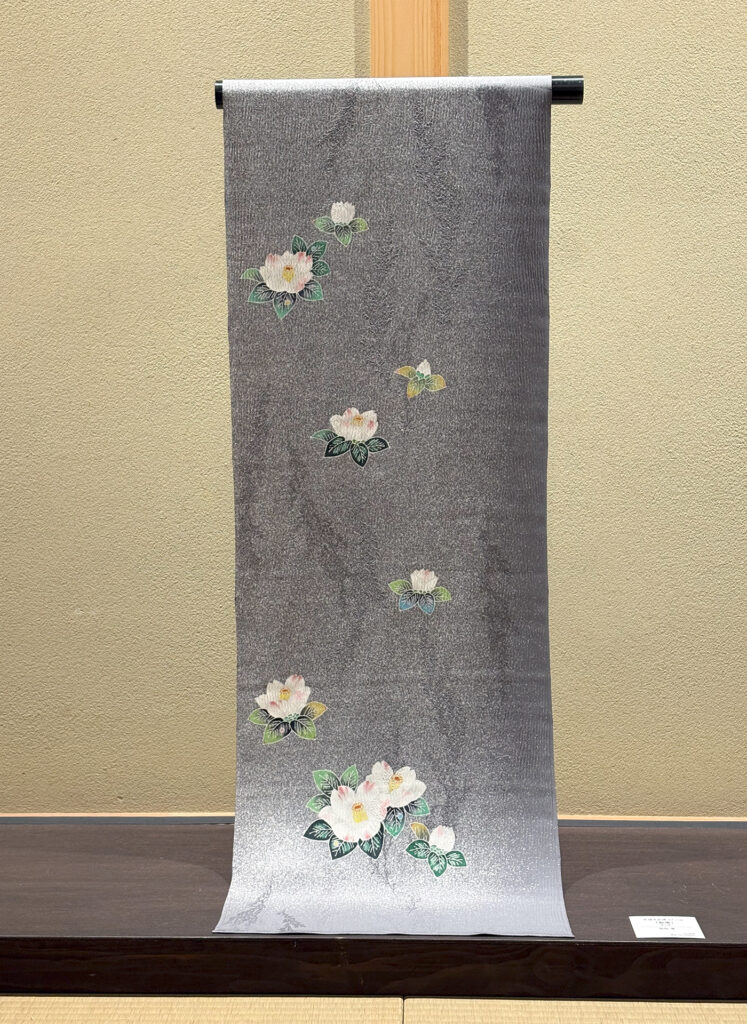
Butterflies appear on a pale blush stole, and white camellias on a soft gray one.
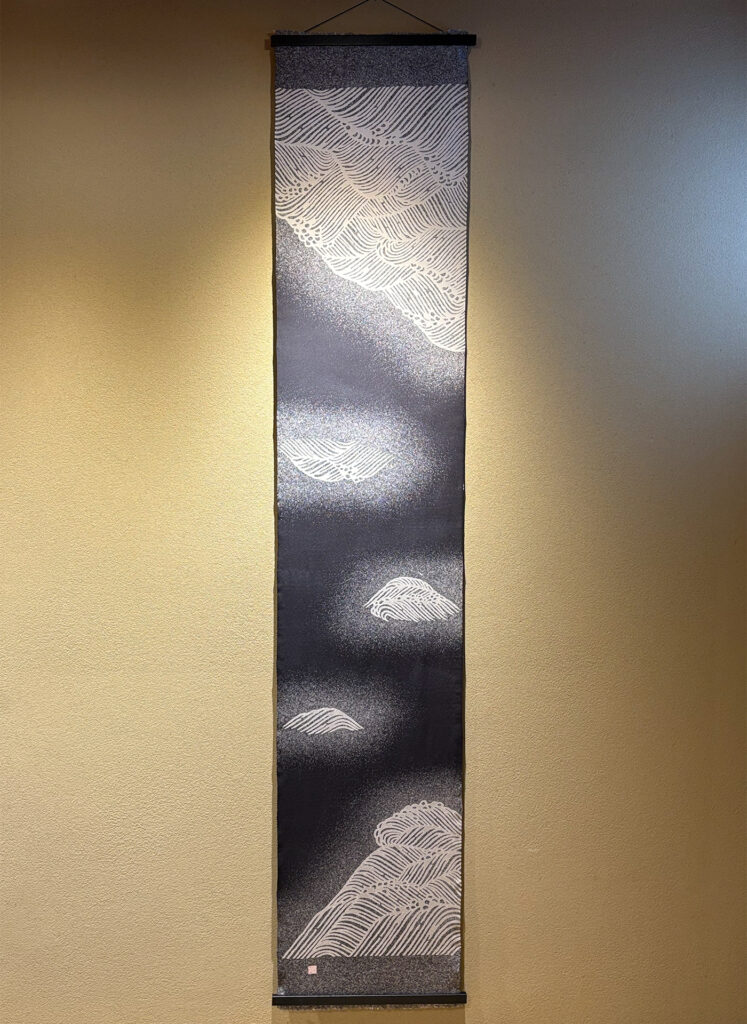
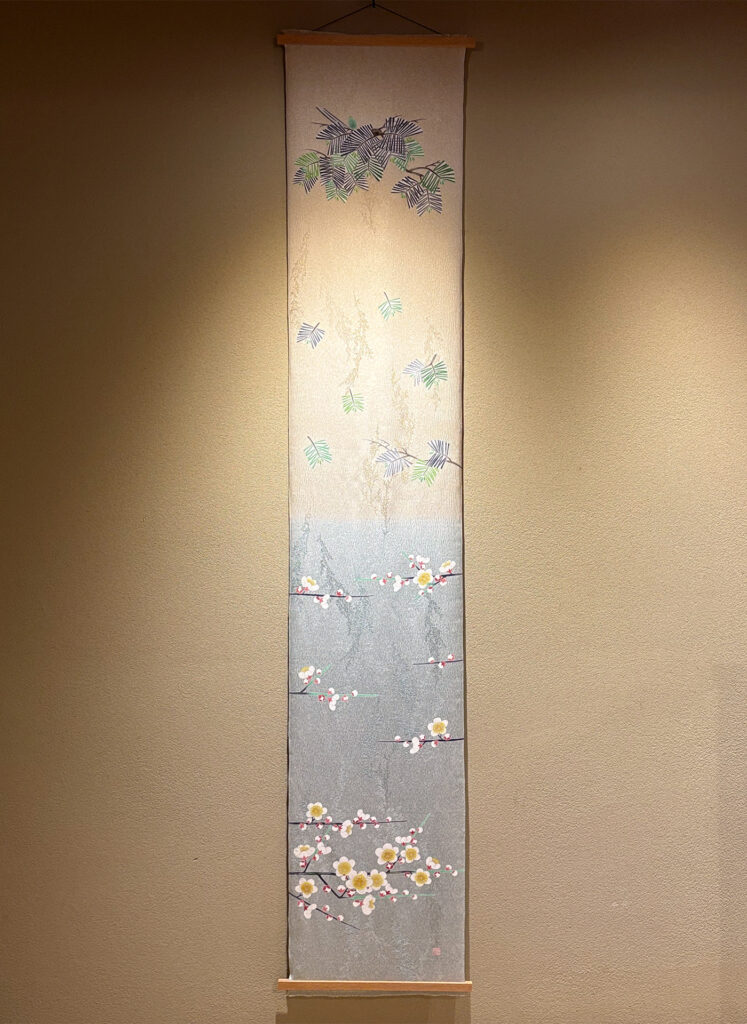
Silvery waves drift across a midnight ground, and pine and plum blossoms bloom on another stole.
Each of these stoles can be worn around the shoulders or hung on the wall like a scroll and enjoyed as an objet d’art. Wear it one season, display it the next.
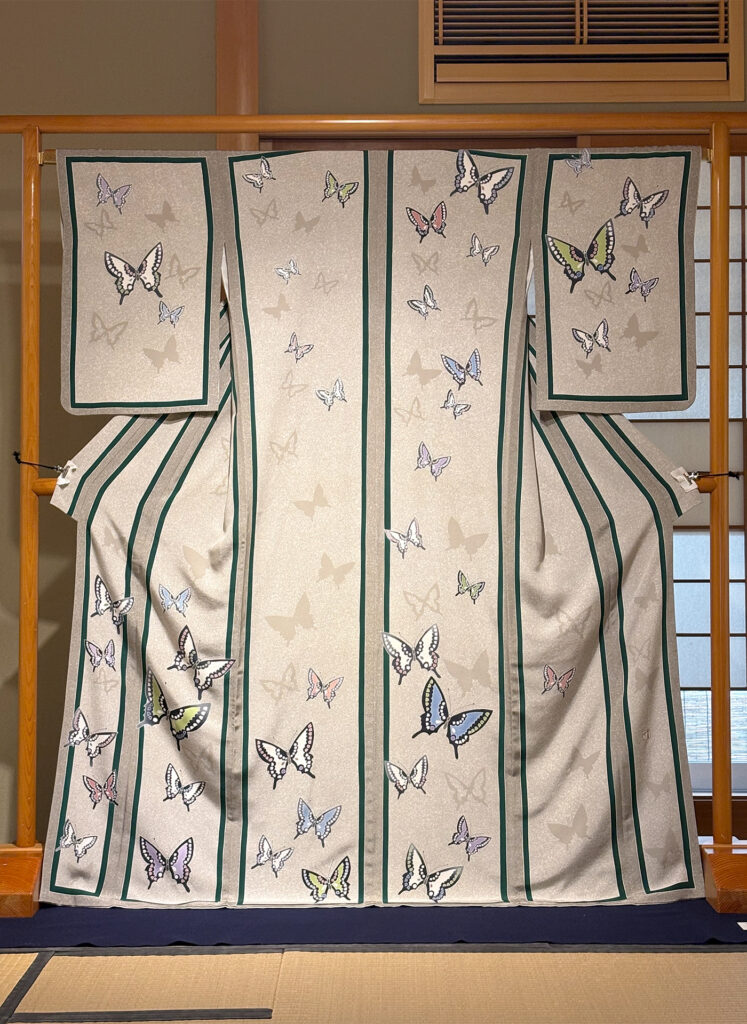
Among the full kimono was a butterfly piece on a beige ground, striped in deep green. It reminds us that the same hands, the same silk and the same dyes lie behind everything, from a formal kimono to a brooch you could wear tomorrow.
Conclusion: Walking Together into the Future
Here at Kogei Art KYOTO, we work every day beside the makers whose craft we share with the world. That is why this project moved us so deeply. “KIMONO by HATA” is a generous, practical answer to a hard question: how does a great tradition keep its weavers, painters, and tailors working?
We want to stand with the Hata Studio as supporters and to bring this challenge to you around the world. If you love textiles, Japanese craft, or the idea of wearing something made with real care, we hope you will follow this project with us.
Wear the art. Carry the tradition into the future.