A story about Ryozo Shibata, a collector’s lifelong devotion, and the invisible threads that connect us across decades.
There are encounters that time cannot diminish.
More than twenty years ago, while living in Japan, Haitham Ghattas — a British collector now based in Hong Kong — first came across the ceramics of Ryozo Shibata through galleries and art dealers. Something in those works stopped him. Shibata’s singular technique of zōgan-sometsuke — the meticulous inlaying of fine cobalt lines into white porcelain before firing — produces objects that seem to exist between drawing and sculpture, between stillness and movement. Haitham purchased several pieces.
He has lived with them every day since. Their beauty has not diminished with time; if anything, it has deepened.
In 2008, drawn back by an admiration that had only grown, Haitham visited Shibata-san’s studio in Kyoto, where the master showed him many of his works. It was the kind of encounter that deepens a collector’s relationship with an artist from appreciation into something closer to devotion.

Then, this month, Haitham began planning a return trip to Kyoto with his wife, Aira. Browsing the web in preparation, he discovered Life with Kogei — and recognized, immediately, the unmistakable work of the artist he had never stopped thinking about. He sent us a message.
That single inquiry set something in motion.
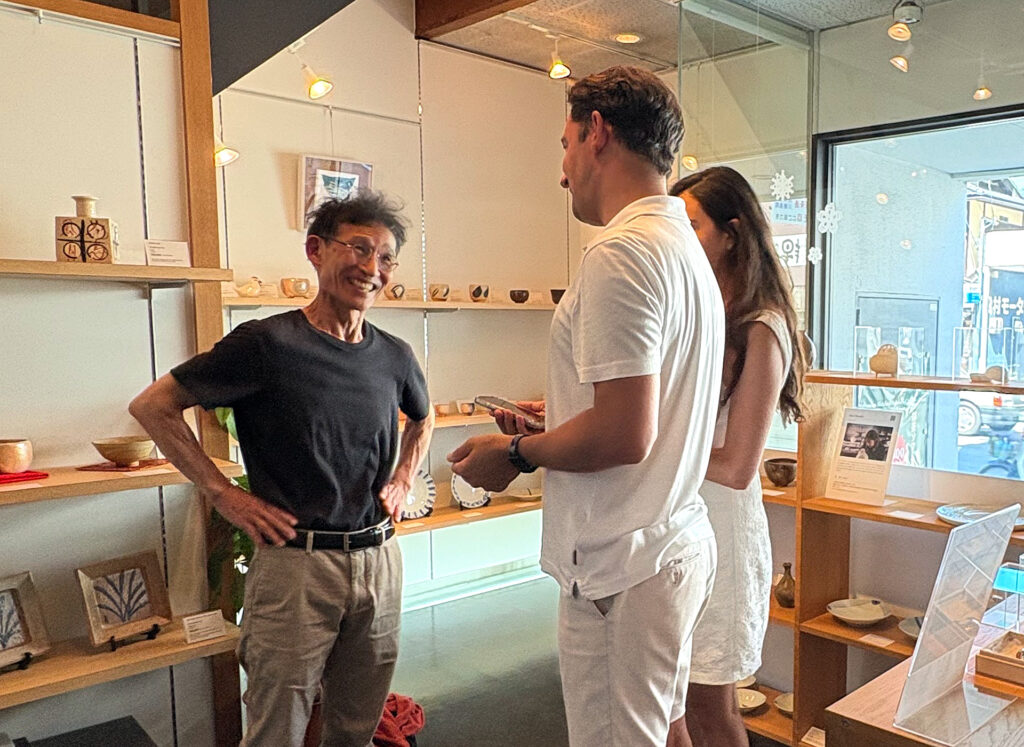
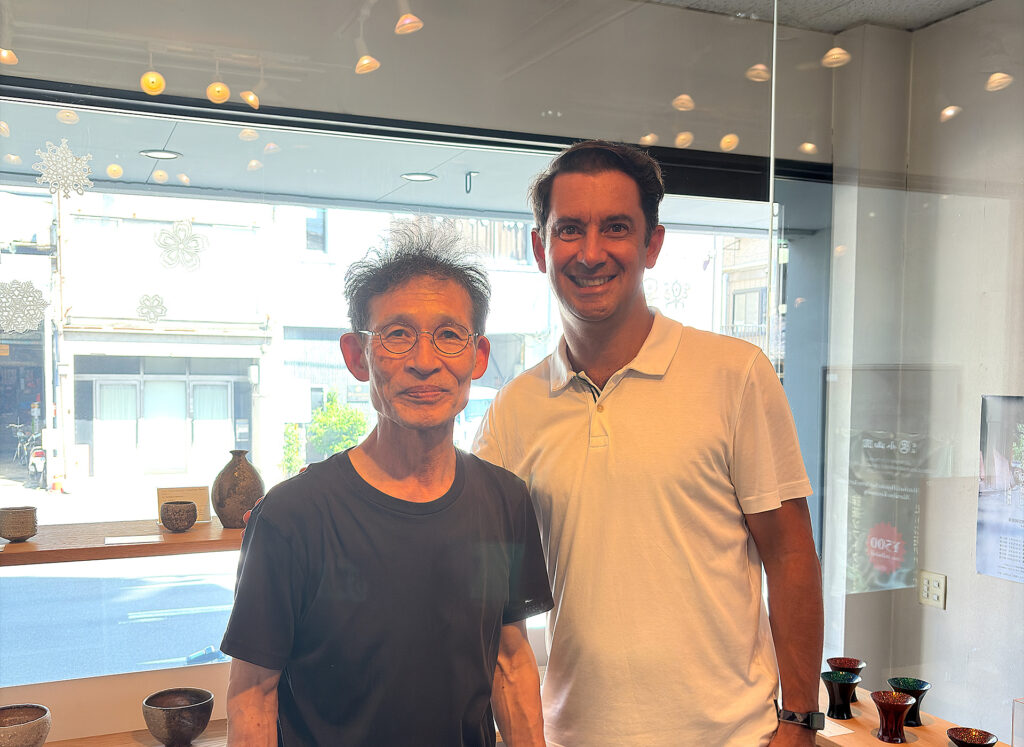
We arranged for Shibata-san to visit our gallery store, and on a Tuesday afternoon in Kyoto, the years between collapsed into a handshake, and then laughter. Haitham and Aira moved through the space unhurriedly, the way people do when they know they are somewhere that matters. Shibata-san — characteristically warm, characteristically understated — received them as though the thread between them had never broken. Because, in truth, it hadn’t.
The following day, we drove to the Ghattases’ hotel and brought them to Shibata-san’s private atelier. This is a space not easily entered — a working studio dense with the accumulated presence of decades of making. Shibata-san’s wife joined them, and together the four of them spent an unhurried morning with the artist’s finished works: bowls, vessels, and sculptural forms, each one carrying the quiet authority of zōgan-sometsuke at its most refined.
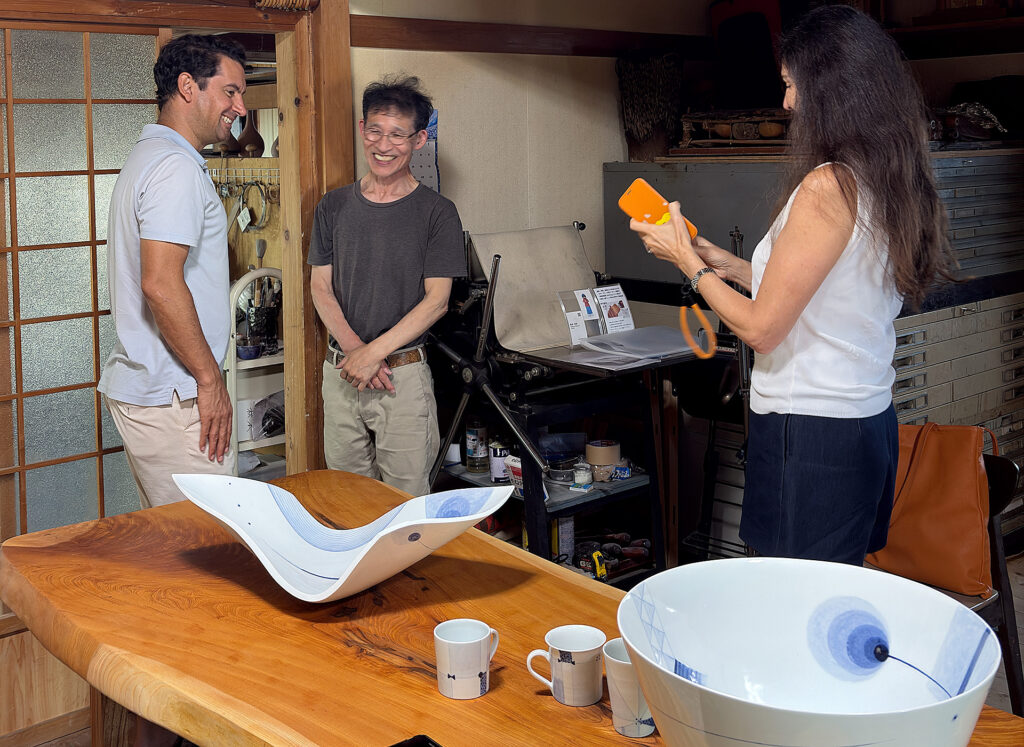
By the end of the visit, Haitham had made his decision. He would add a new Shibata masterpiece to his collection: the Large Bowl with Inlaid Line and Cobalt Pattern — a major work in the artist’s signature technique. Wide and serene, its surface alive with the precise blue geometry that defines Shibata’s practice, it is the kind of object that changes a room simply by being present.
Our team handled everything that followed: processing the payment, coordinating meticulous international packaging, and arranging secure shipment to Hong Kong. We then drove Haitham and Aira back to central Kyoto — a small gesture, but one that felt entirely right for a day that had been, from first to last, about relationships.
The bowl is now in Hong Kong. Alongside the pieces Haitham first acquired over twenty years ago, it takes its place in a collection shaped not by the market, but by a deep and enduring love for one artist’s vision.
This is what we believe Japanese craft is capable of: not merely beautiful objects, but living bonds between artists and the people whose lives they enter — bonds that survive distance, survive time, and only seem to grow stronger.
Ryozo Shibata’s works are available through Kogei Art KYOTO. For inquiries about private viewings, atelier visits, or international acquisitions, please contact us directly.
→ Explore Ryozo Shibata’s Profile and works on Kogei Art KYOTO: https://kogeiart.kyoto.jp/artists/ryozo-shibata/