When Taishō Romance Returns to Kyoto
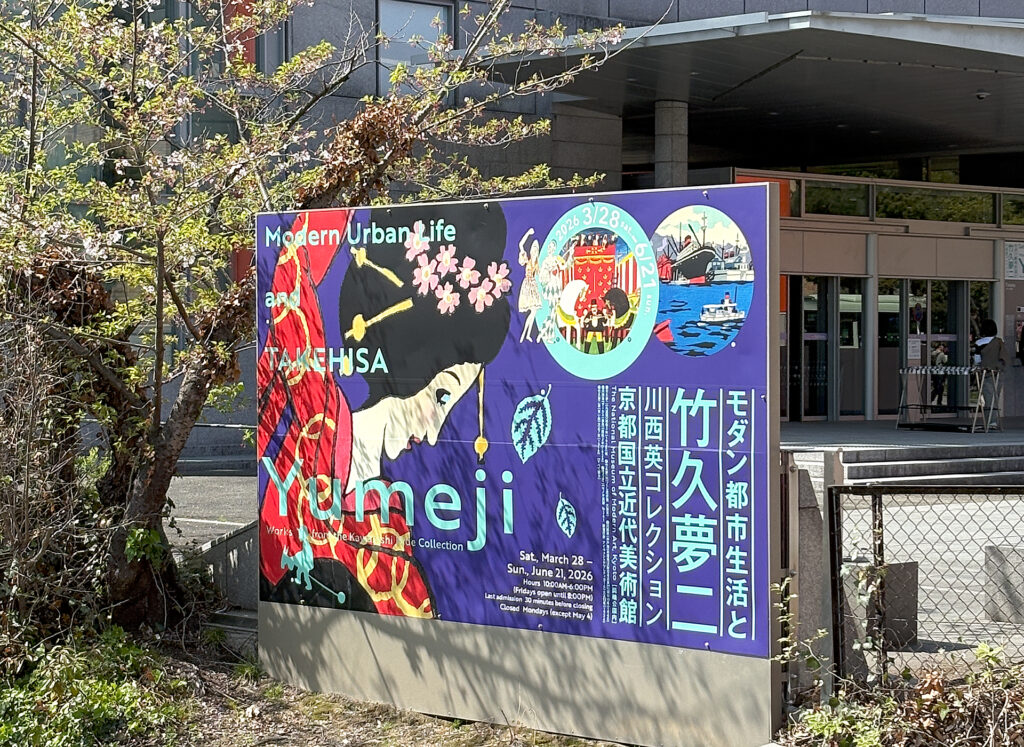
Along the canal in the Okazaki district, where cherry blossoms scatter across still water each spring, the National Museum of Modern Art, Kyoto, stands as a quiet sentinel of Japan’s modern artistic heritage. This spring, its galleries have been transformed into a vivid portal to another era — one of longing glances, bold graphic design, and an artist who refused to confine beauty to the walls.
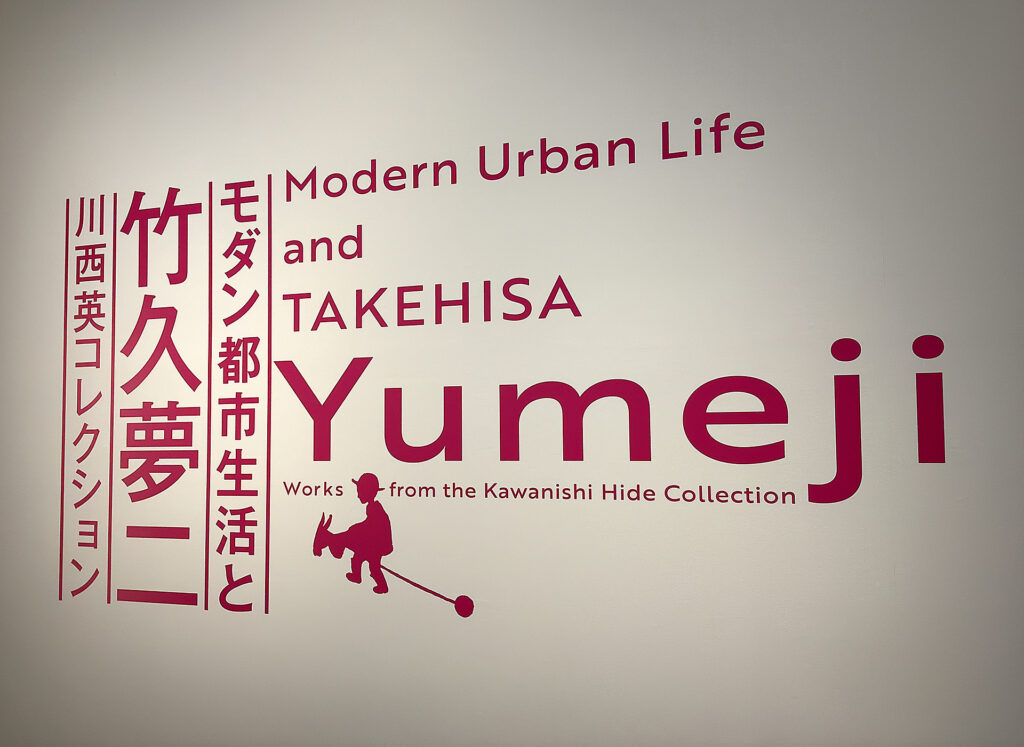
“Modern Urban Life and Takehisa Yumeji: The Kawanishi Hide Collection” runs from March 28 through June 21, 2026. With nearly 400 works on display — prints, book designs, postcards, textile patterns, and everyday objects — the exhibition reveals Yumeji not merely as the revered master of Taishō-era art he is remembered as today, but as something far more intimate: an illustrator, a designer, and a dreamer who believed that art belonged in the fabric of daily life.
For us at Kogei Art KYOTO, this exhibition holds significance that goes beyond admiration. Within these galleries, we discovered a quiet trace of our own origin story — a name written in Yumeji’s own hand, glowing softly from the page of a century-old book.
A World Shaped by Beauty and Longing
Stepping into the exhibition is like entering a Taishō-era reverie. The galleries unfold in a carefully orchestrated sequence, guiding visitors from Yumeji’s delicate portraiture through to his remarkably modern approach to graphic and textile design.
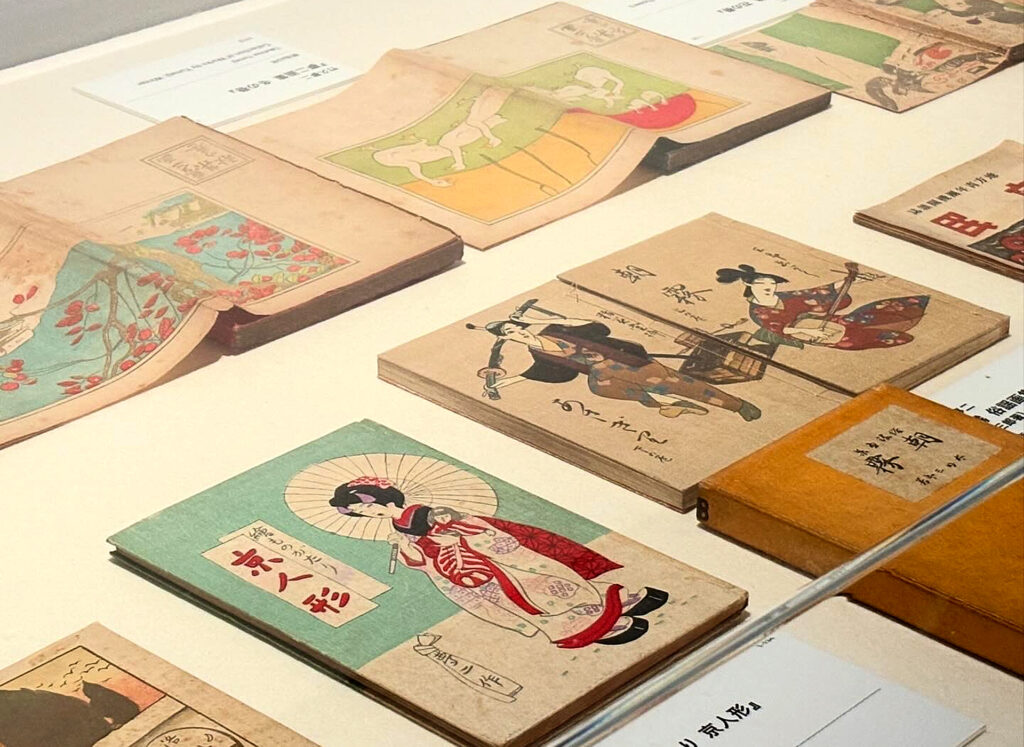
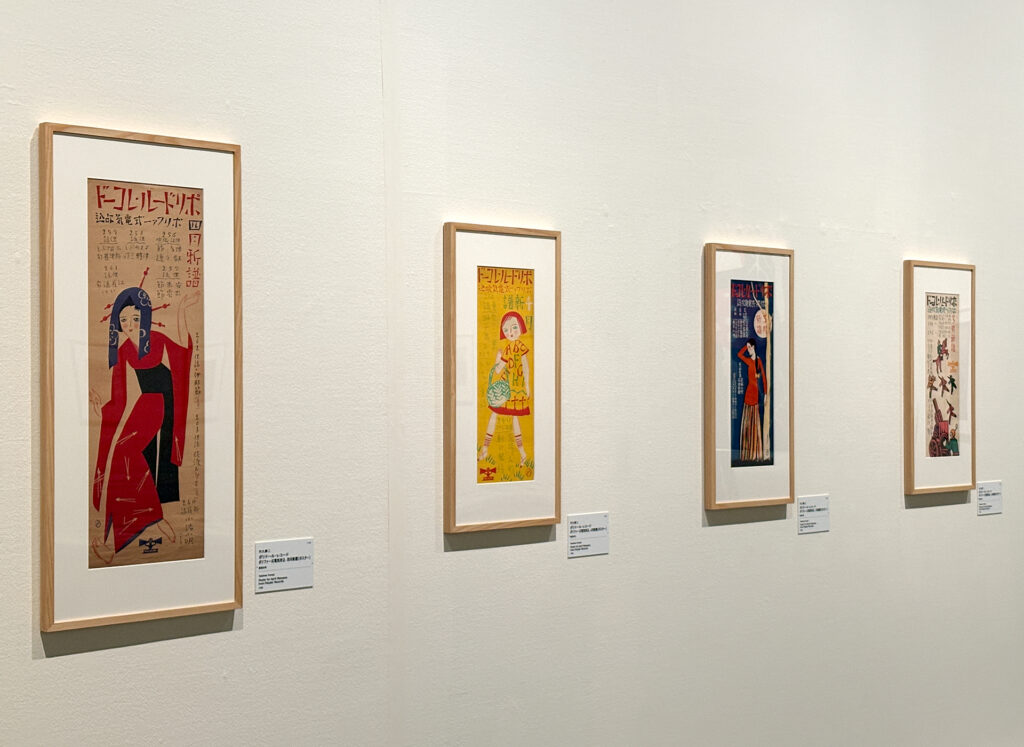
The first impression is one of sheer range. Yumeji designed covers for the celebrated Senoo Music Scores series, transforming sheet music into small works of art. He created illustrations for literary magazines, drew postcards that were sold and collected by ordinary people across Japan, and conceived patterns for furoshiki wrapping cloths and chiyogami decorative paper. Long before the term “graphic designer” existed in Japan, Yumeji was one — and a visionary at that.
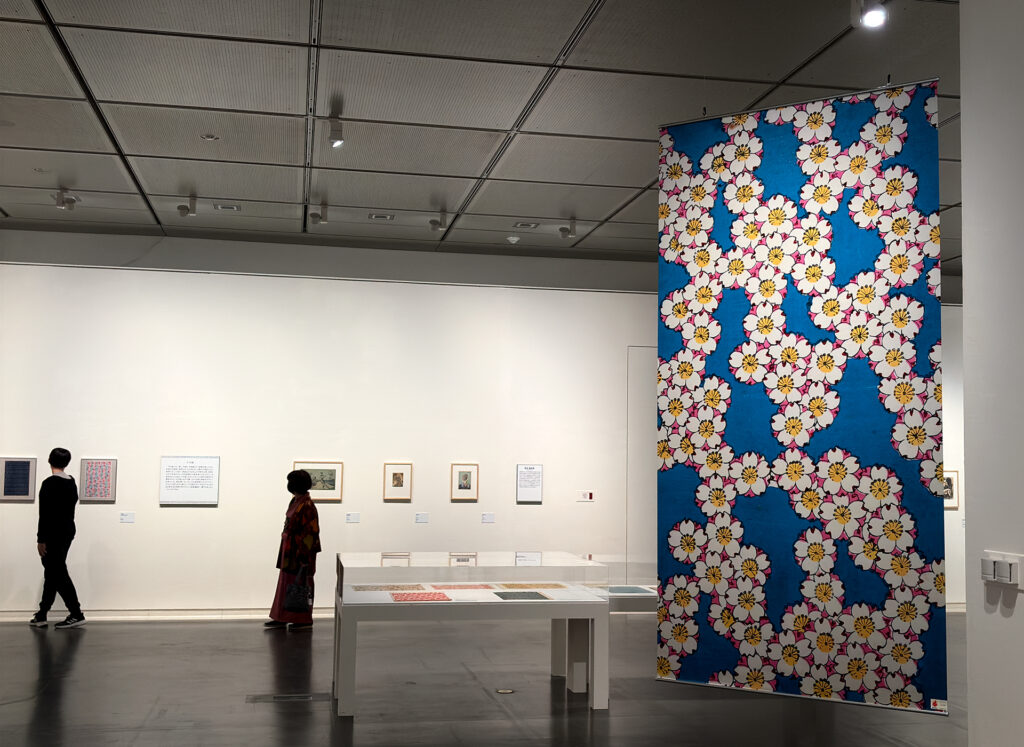
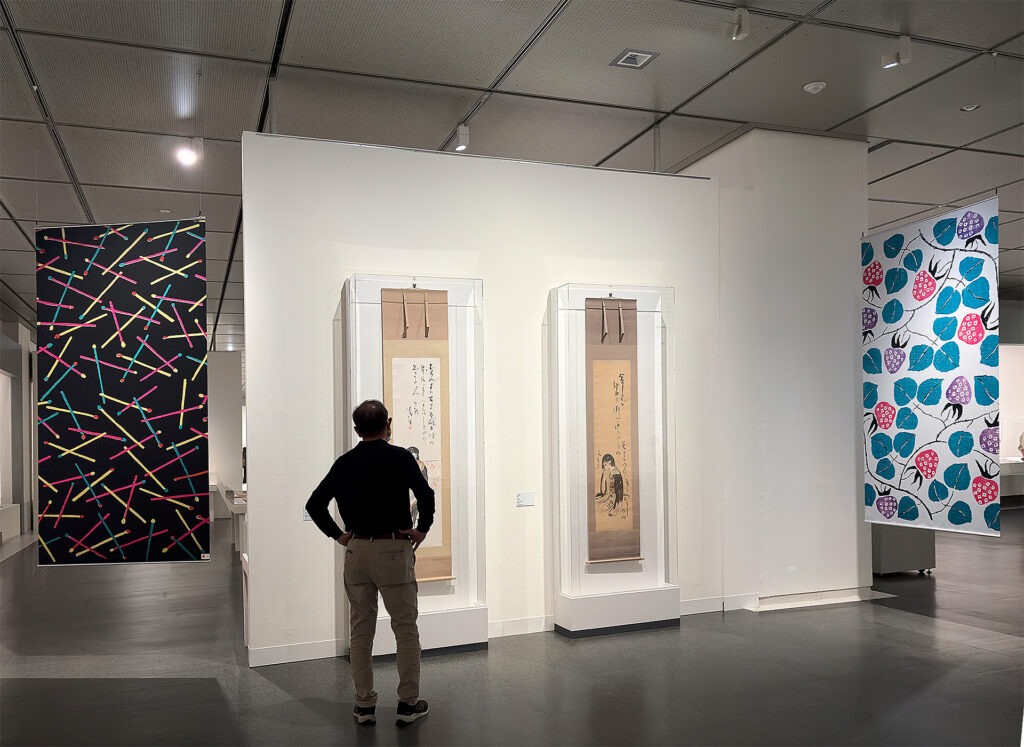
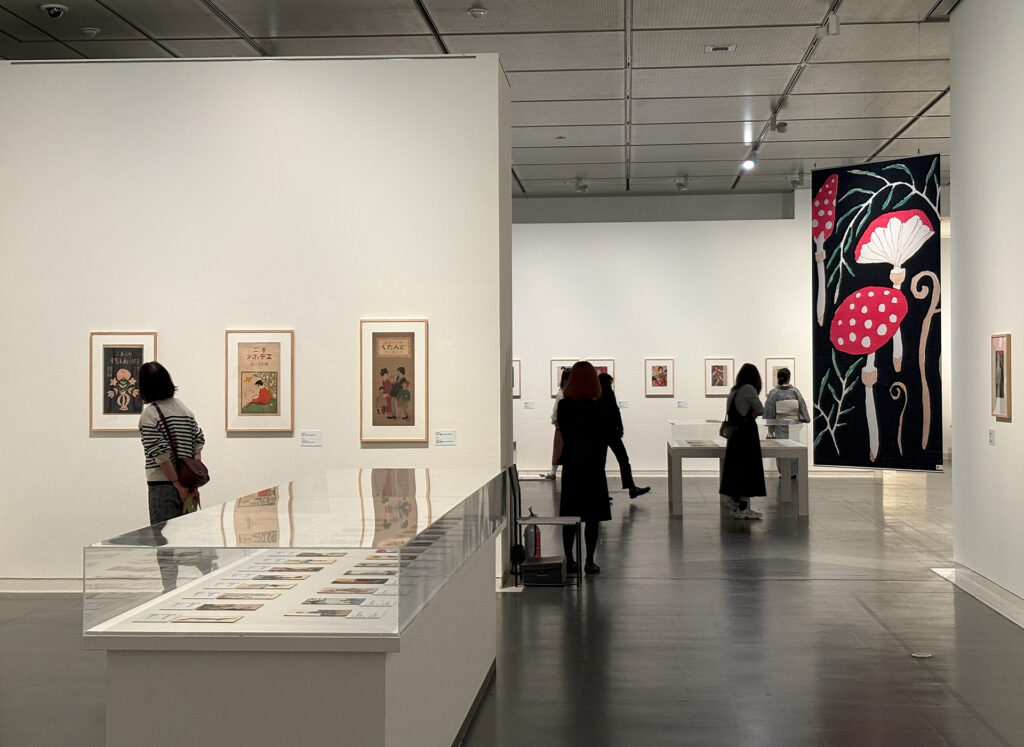
The exhibition space itself becomes a canvas. Large-scale tapestries — reproductions of Yumeji’s bold, surprisingly modern patterns of cherry blossoms, mushrooms, and organic forms — hang from the ceiling to the floor, enveloping visitors in a world where decoration was never merely decorative but an expression of a philosophy: that beauty should permeate every corner of life.
It is this conviction — that art is not a luxury set apart from living, but a force that elevates the everyday — that resonates so deeply with the philosophy of kogei, the Japanese craft arts we celebrate at Kogei Art KYOTO.
The Gaze of Yumeji: Portraits That Still Speak
No encounter with Yumeji’s world would be complete without his iconic portraits of women — the Yumeji-shiki bijin, or “Yumeji-style beauties.” These are not the idealized, unapproachable figures of classical Japanese painting. Yumeji’s women carry a quiet melancholy in their downcast eyes, a wistfulness that seems to reach across a century and still touch something deeply human.
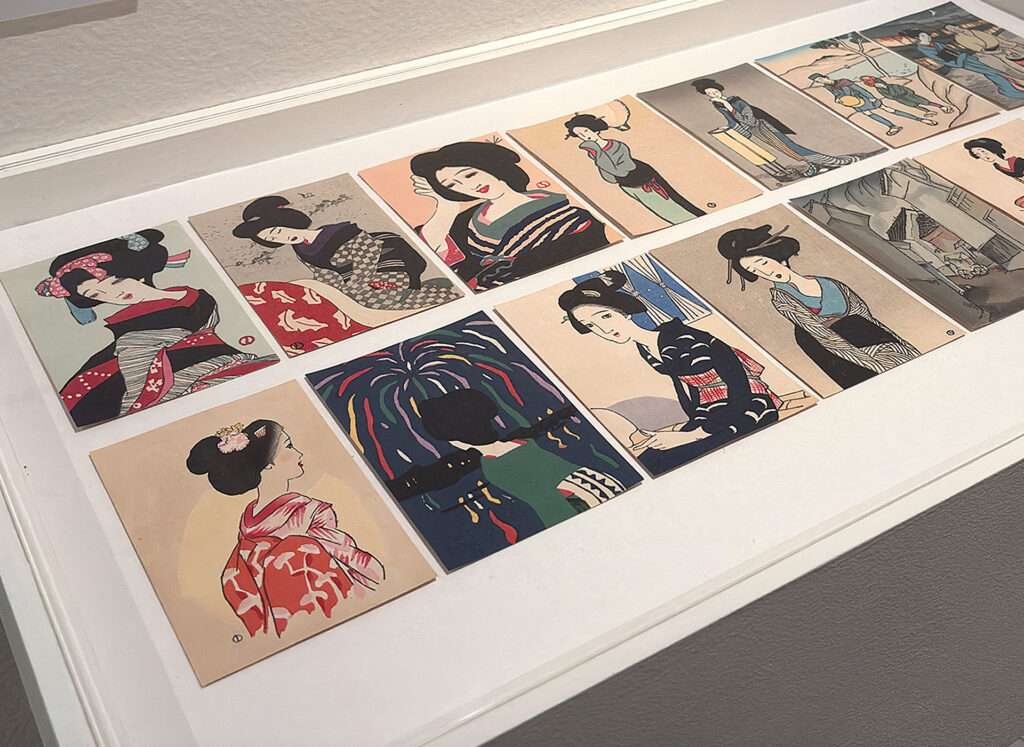
In the exhibition, a selection of original postcards presents these figures in intimate scale — small enough to hold in the palm of your hand, yet profound in their emotional weight. They remind us that Yumeji was, above all, an artist of feeling. His work did not seek to impress; it sought to move.
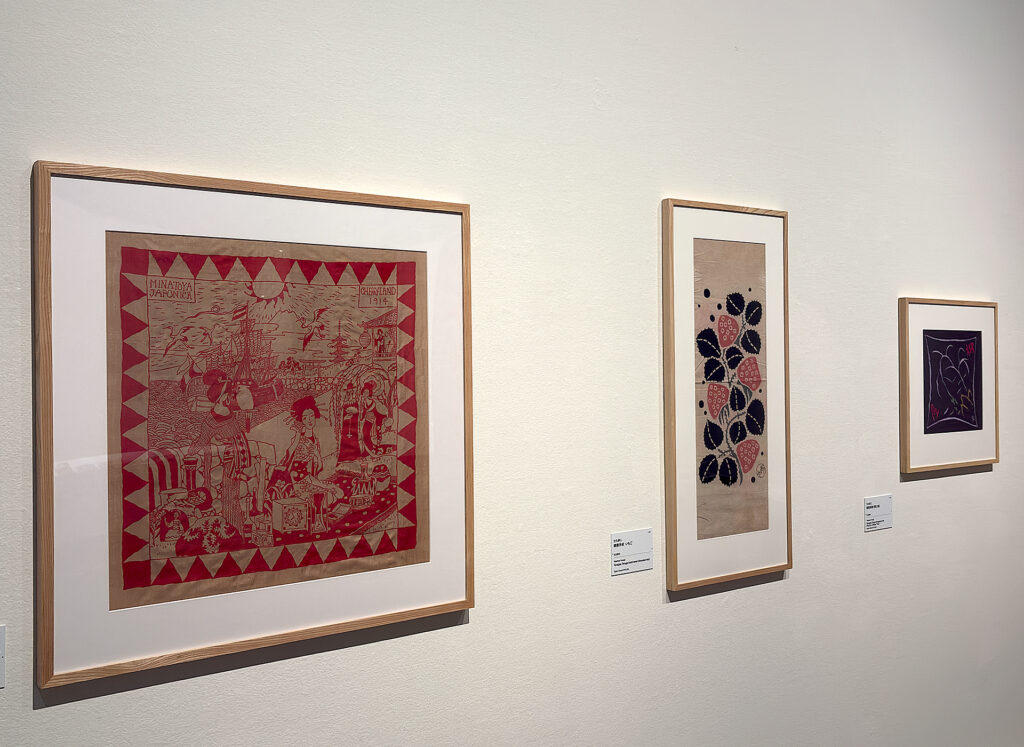
The collection also features works by artists who were inspired by Yumeji — the printmaker Kawanishi Hide, after whom the collection is named, as well as Onchi Kōshirō and other Shōwa-era artists who carried the spirit of Taishō modernism forward into new visual languages. Together, they paint a picture of a creative community bound not by school or doctrine, but by a shared belief in art’s power to illuminate ordinary life.
A Name in a Painting: The Discovery That Connects Us
And then, in a glass case near the heart of the exhibition, we found it.
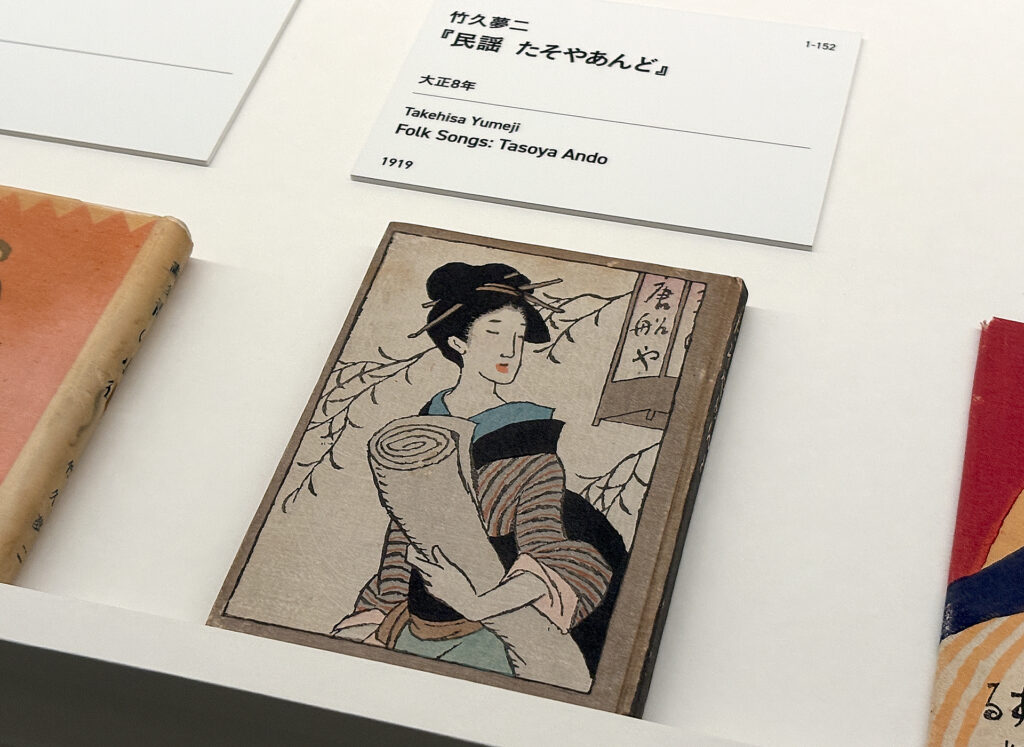
Minyō Tasoya Ando — a collection of folk songs with woodblock-printed illustrations, published in 1919. The book lies open beneath museum lighting, its pages softened by more than a century. On the cover, a woman holds a scroll, and beside her, rendered in Yumeji’s unmistakable hand, stands what appears to be a signboard. The characters written upon it read: 唐船や — Karafuneya.
For most visitors, this is simply one charming detail among many. For us, it is a mirror reflecting the very beginning of our story.
KARAFUNEYA Co., Ltd. — the company that operates Kogei Art KYOTO — was founded in 1921 as Karafuneya Insatsujo, a printing house in the heart of Kyoto. Its founder, Horio Kōtarō, was a man deeply embedded in the cultural life of Taishō-era Kyoto. He counted among his friends and acquaintances the writers, poets, and artists who gathered in the city during that remarkable period of creative ferment — and among them, Takehisa Yumeji.
The connection between Yumeji and KARAFUNEYA runs deeper than friendship. In several of Yumeji’s paintings and illustrations, the name Karafuneya appears — inscribed on andon lanterns, painted on shop signboards, woven into the scenery of his imagined streetscapes. It is from these very images that the first president, Horio Kōtarō, is said to have taken the name for his company. The artist’s brush, in other words, christened our enterprise.
There is more. The “ship mark” logo — the emblem that KARAFUNEYA has used since its founding over a century ago — is widely believed to have been designed by Yumeji himself. Although definitive documentation remains elusive, scholars familiar with the publishing and printing world of that era consider the attribution highly probable. The elegant simplicity of the mark, its graceful lines, and its unmistakable kinship with Yumeji’s design sensibility all point to the same hand.
A Heritage of Eyes and Hands
What does it mean for a company to carry a name given by an artist? For KARAFUNEYA, it has meant something profound: an enduring sense of responsibility to the world of art and craft.
From its earliest days as a printing house — working with woodblock and letterpress techniques that themselves constitute a form of kogei — KARAFUNEYA cultivated relationships with Kyoto’s creative community. The founder’s circle of literary and artistic friends was not a matter of patronage or commerce alone; it reflected a genuine belief that the work of printing, of giving physical form to words and images, was itself a creative act deserving of aesthetic care.
That sensibility has been handed down through generations. Today, KARAFUNEYA operates not only as a printing and design production company with comprehensive in-house capabilities — DTP, copywriting, graphic design, web design, and photography — but also as the force behind Kogei Art KYOTO, a platform dedicated to introducing the world to the finest contemporary craft artists working in Kyoto and across Japan.
From Yumeji’s Lantern to the Living Light of Kogei
Standing before Minyō Tasoya Ando in the hushed gallery of the National Museum of Modern Art, one feels the gentle pull of a thread stretching back more than a hundred years — from Yumeji’s ink to our founder’s hand, from a Taishō-era printing press to the ceramics, lacquerware, and textiles we present to you today.
Takehisa Yumeji believed that beauty should not be imprisoned behind glass. He wanted it on your shelves, in your letters, wrapped around the gifts you carry to a friend’s home. That same conviction — that art and life are not separate realms, but one continuous, breathing whole — is the founding spirit of Kogei Art KYOTO.
The artists we represent carry this legacy forward. Each piece in our collection — whether a tea bowl shaped by flame, a lacquer box bearing months of patient handwork, or a length of yūzen-dyed silk — is made to be lived with, touched, used, and cherished. They are not relics of the past. They are the living continuation of a tradition that Yumeji, in his own way, championed a century ago: the tradition of yō no bi — the beauty found in use.
We invite you to visit this extraordinary exhibition before it closes on June 21, 2026. And we invite you, as always, to explore the world of Kogei Art KYOTO — where a century of aesthetic conviction meets the unparalleled artistry of today’s master craftspeople.
Exhibition Information
Modern Urban Life and Takehisa Yumeji: The Kawanishi Hide Collection
| Venue: | The National Museum of Modern Art, Kyoto (Okazaki Park, Sakyō-ku, Kyoto) |
| Dates: | March 28 – June 21, 2026 Hours: 10:00 AM – 6:00 PM (until 8:00 PM on Fridays); last admission 30 minutes before closing. |
| Closed: | Mondays (except May 4, a national holiday) |
| Admission: | Adults ¥1,800 / University students ¥1,100 / High school students and under 18: Free |
Kogei Art KYOTO is operated by KARAFUNEYA Co., Ltd., a Kyoto-based company founded in 1921. To learn more about our history and mission, visit our About Us page.