Universe of Kogei · Lacquer Arts
From the sap of a forest tree to the depths of an infinite black, how Koken Murata, Issey Hattori, and Kenji Omachi are reimagining Japan’s most ancient art form.
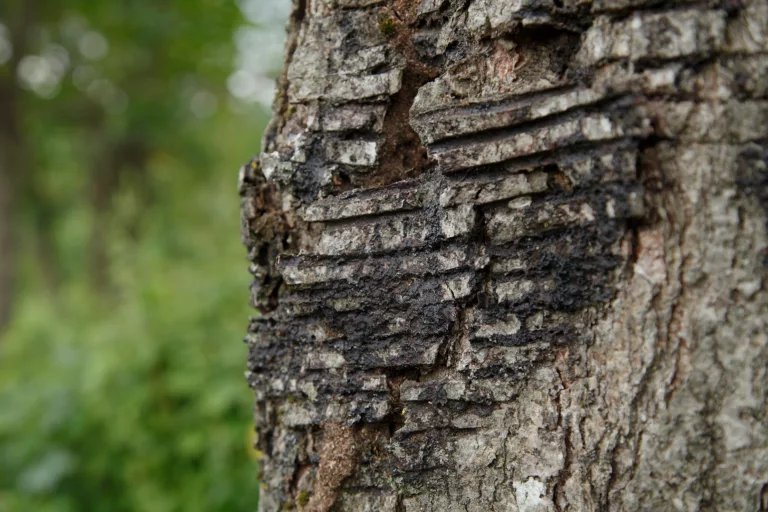
There is a moment, somewhere between the tenth and the twentieth layer of lacquer, when something shifts. What began as a liquid resin — harvested by hand from the bark of the Toxicodendron vernicifluum, the lacquer tree — starts to become something else entirely: a surface that seems to hold light, to breathe, to possess an interior depth that no paint or varnish can replicate. This is urushi.
For over fourteen thousand years, since the Jomon period, the people of Japan have known this transformation. They used lacquer to waterproof, to sanctify, to decorate the armor of samurai and the vessels of the tea ceremony. Over the centuries, a constellation of techniques emerged — makie, the art of sprinkling metal powders onto wet lacquer; raden, the inlay of iridescent shell; tsuishu, the carving of dozens of accumulated red layers — each one a different way of coaxing beauty from a substance that hardens only in darkness and humidity.

Today, at Kogei Art KYOTO, three lacquer artists carry this inheritance forward. Each begins from the same ancient material. Each arrives somewhere entirely their own.
Artist I
01
Lacquer Artist
Koken Murata


Koken Murata’s work begins not in the studio but in meditation. During a period of Zen practice, he experienced what he describes as a brilliant light flowing down on him — a sensation that dissolved his sense of self and revealed, in its place, the vast cycle of nature. That vision became the animating principle of everything he has made since.
“As the light overcame me and I sought that light, I saw my own trivial existence in nature. That is what inspired me to create artwork that represents light and water flowing down from heaven.”

His medium is the deep blackness of lacquer — a darkness so complete it functions less as a colour than as a void, a sky, a still surface of water at night. Into this darkness Murata places gold and silver leaf, working freely across both two-dimensional panels and sculptural forms to produce works of extraordinary luminosity. The characteristic black of lacquer, he has found, does not compete with metal and shell: it amplifies them, drawing out an inner radiance that seems to emanate from within the work itself.
Murata’s work has been shown across four continents — the United States, the Netherlands, France, Norway, Vietnam, Taiwan, Hong Kong, and China — and has been recognised with some of Japan’s most prestigious prizes, including the Minister of Education, Culture, Sports, Science, and Technology Award and the Nitten Member’s Award.
Primary technique
Makie with gold & silver leaf; raden shell inlay
Theme
Light, water, the cycle of life
Recognition
Minister of Education Award; Nitten Member’s Award; Kyoto Prefecture Cultural Award
He teaches at Kyoto Seika University and serves as executive director of the Japan Kougei Nikkoukai Institute, transmitting the tradition while pushing relentlessly at its edges. His guiding conviction is that the techniques inherited from the past are not an endpoint but a foundation — and that the true obligation of a living artist is always to exceed what came before.
Earth, Sky and Sea — Koken Murata

View artwork →
View all works by Koken Murata →
Artist II
02
Lacquer Artist
Issey Hattori
The Japanese language has a word that exists specifically for the black of lacquer: shikkoku. It is not simply a dark colour. It is a quality — a depth, a completeness of absorption — that distinguishes lacquer black from every other black in the world. For Issey Hattori, this colour is not a background. It is the subject.
“My work pursues the beauty that can be expressed with gold Maki-e and inlaid mother of pearl placed in the Shikkoku background.”

Hattori’s practice centres on a particular insistence: he makes everything himself, beginning with the forms on which he will apply lacquer, proceeding through each stage of the process by his own hand. The surface he builds through charcoal polishing — an ancient method that creates thousands of microscopic scratches, then fills them with lacquer dust to produce the characteristic Japanese gloss — is not a background he inherits but one he constructs, layer by patient layer.

Into this surface he carves in millimetre increments, a technique demanding precision that borders on the surgical. He inlays abalone, green turban shell (turbo marmoratus), and in some works the iridescent wing cases of jewel beetles — materials that respond to light the way clouds respond to sunset, shifting through colours that cannot be predicted in advance.
His thematic world moves through air, wind, light, and sky: elemental presences that the finished works seem not to depict but to embody. Hattori became independent as an artist only in 2018, after nearly two decades of study and formal apprenticeship. In just a few years since, he has won the Japan Kougei Nikkoukai Award, the Kyoto Governor’s Award, and First Prize at the All Kansai Art Exhibition.
Signature approach
Millimetre-precision carving; hand-built forms; charcoal polishing
Materials
Gold & silver makie powder; abalone; turbo shell; jewel beetle wing cases
Recognition
Japan Kougei Nikkoukai Award; Kyoto Governor’s Award; First Prize, All Kansai Art Exhibition
Faraway — Issey Hattori

View artwork →
View all works by Issey Hattori →
Artist III
03
Lacquer Artist
Kenji Omachi
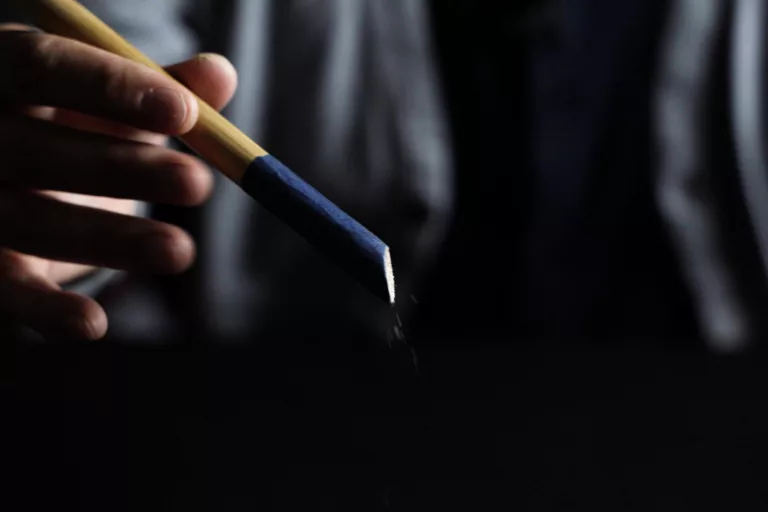
For over four decades, Kenji Omachi has done what the best traditional artists always do: he has mastered what the past offers, then asked what the past cannot yet imagine. His grounding in classical lacquer techniques — makie, raden shell inlay, the full vocabulary of urushi — is complete and rigorous. But it was through searching beyond this vocabulary that he made the discovery that defines his practice.
“Normally, inlaid mother of pearl sparkles from only one direction. But when I used Kyoto Opal, it sparkled from various angles.”
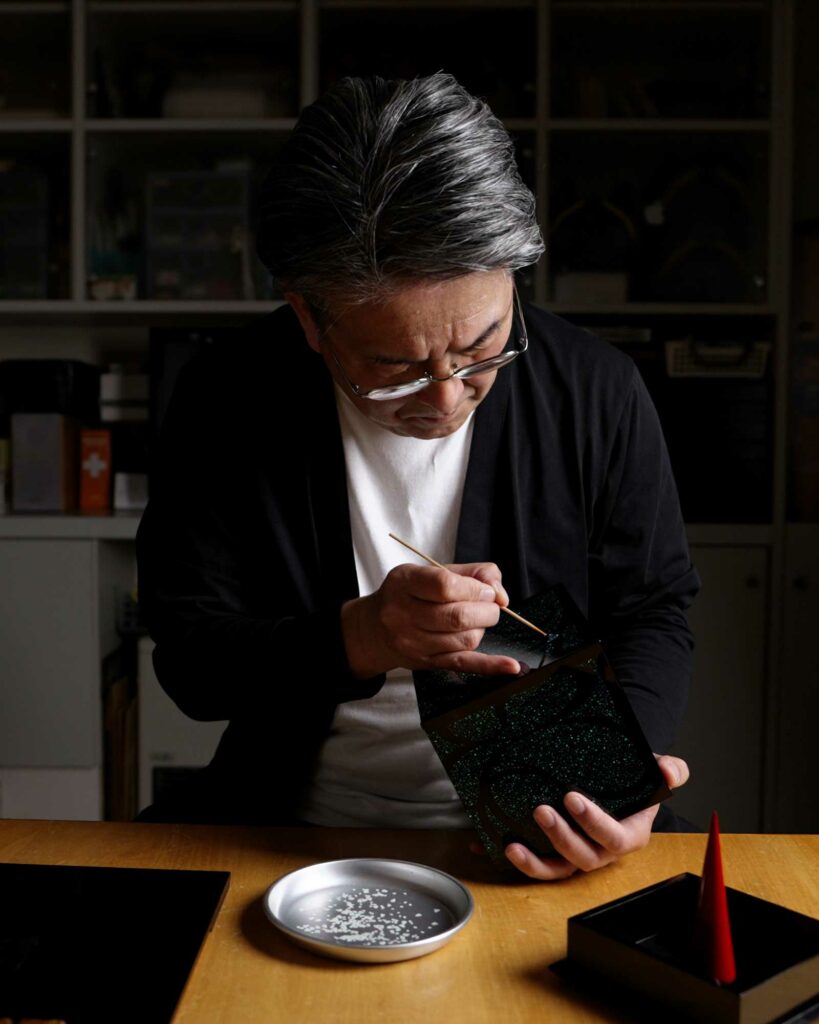
Kyoto Opal is a synthetic gemstone developed by the KYOCERA corporation using advanced materials technology. Its optical properties differ from natural shell in a significant way: where abalone and mother of pearl catch light directionally, Kyoto Opal refracts it from multiple angles simultaneously, producing a quality of luminescence that shifts and multiplies as the viewer moves.
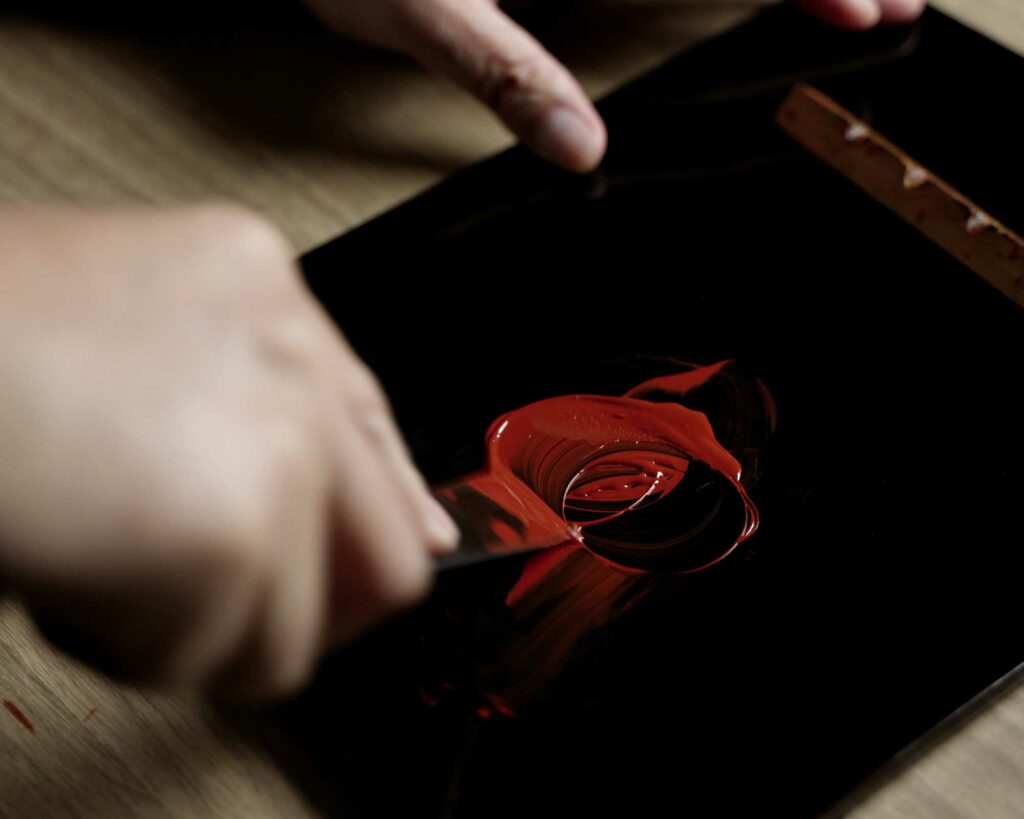
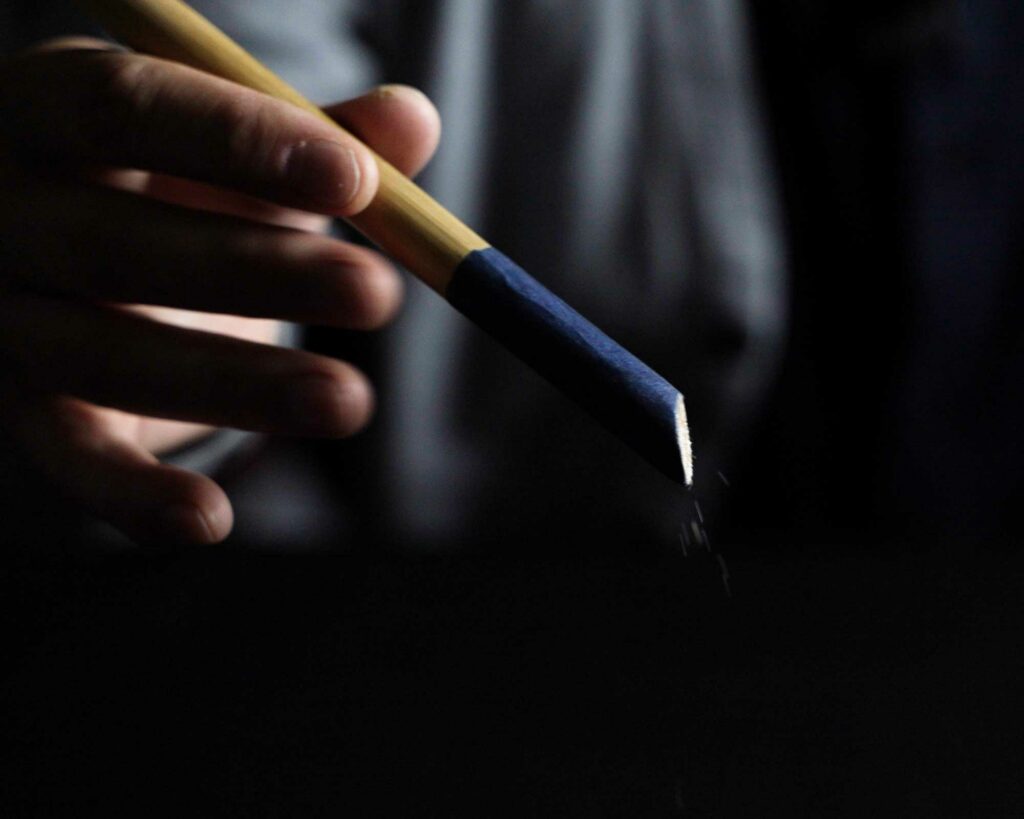
Omachi was among the first lacquer artists to perceive what this material could offer, and he built around it an entirely new technique he named Saikiko — meaning “coloured luminescence.” The technique operates at the intersection of tradition and technology in a way that is unusually literal: he applies the inlay process to surfaces that include 3D-printed forms, creating works that belong to no prior category in the urushi tradition — and yet feel, unmistakably, like its continuation.
Innovation
Saikiko — coloured luminescence with Kyoto Opal inlay
Substrates
Traditional wood and lacquer; 3D-printed bases
Recognition
Kyoto Prefectural Governor’s Award; Kyoto Culture Venture Competition; study residencies in England and France
Saikiko Panels: “Four Emotions” — Kenji Omachi

View artwork →
View all works by Kenji Omachi →
Three voices, one material
What is most striking, when you encounter the work of Murata, Hattori, and Omachi together, is how completely the same ancient substance can be made to speak in different registers. Murata’s panels carry a spiritual charge — light as revelation, the cosmos contained in a lacquered surface. Hattori’s objects are intensely physical, built through accumulated human effort until the surface achieves a depth that seems to have no bottom. Omachi’s works are playful and searching, the conversation between an old craft and a new material conducted with both rigour and delight.
Urushi has survived for fourteen thousand years because each generation finds in it something the previous generation had not yet seen. These three artists are proof that the discovery is not finished — that the lacquer tree still has something to say.
Explore the full collection of lacquer artworks at Kogei Art KYOTO